
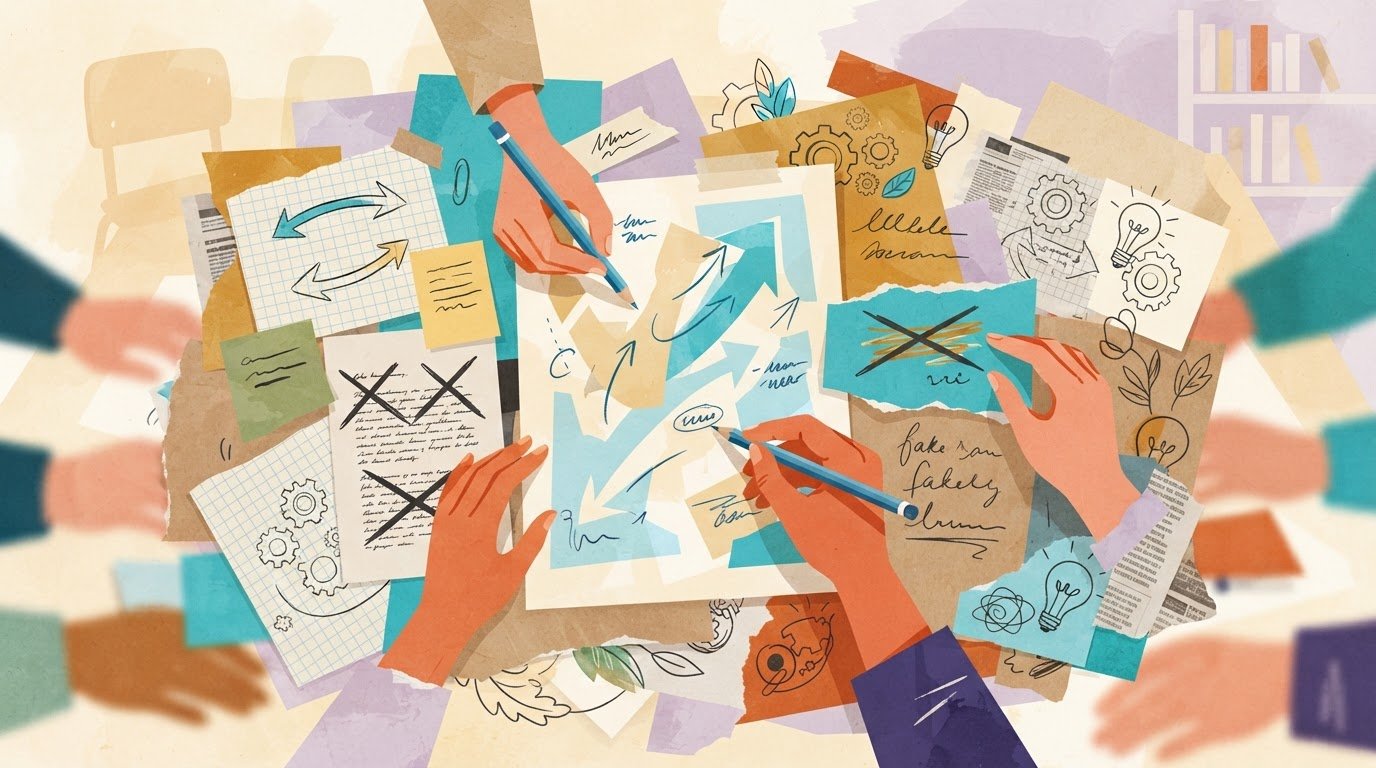
When students display their work, we usually see the final version: a neat paragraph, a completed poster, a solved problem, or a carefully coloured diagram. The final product is useful, but it does not always reveal the decisions made along the way. A learner may have changed an idea, tested a sentence, abandoned an approach, asked for help, or discovered a mistake. That thinking often disappears when the page is cleaned up.
Rough work is not merely a step towards the finished work; it can be evidence of learning itself. This matters especially in activities where creativity, reasoning, and problem-solving are central. If we evaluate only the finished result, we may miss the process that deserves feedback.
Let the process remain visible
Keeping drafts visible does not mean every page must be saved or displayed. It means creating a small, purposeful opportunity to show how an idea is changing. Students might keep an initial sketch beside a revised one, mark a sentence they improved, note a question they still have, or record why they selected one solution over another. The process can be brief and manageable.
In a writing task, a first attempt might focus on getting the idea down. The next attempt could add a reason or example. In a creative task, students may draw several small possibilities before choosing one. In a problem-solving task, they can record an approach that did not work and what they tried next. These traces make the learning journey easier to discuss without turning every activity into a lengthy portfolio.
Feedback can be more precise
A teacher who sees only the final answer may say, “Make it clearer.” A teacher who sees a draft can respond to a particular decision: “You have two ideas here; can you show how they connect?” or “This example supports your point. What evidence would make the next sentence stronger?” Students can also give more specific feedback to one another because they are responding to a developing idea rather than a finished object.
- Keep one early version: a sketch, outline, first sentence, or initial solution.
- Mark one change: underline, arrow, or brief note showing what was revised.
- Explain one decision: “I changed this because…”
- Ask one next question: what could be tested, clarified, or improved?
First idea → attempt → feedback or new evidence → revision → short reflection. Keep the trace small enough to use during an ordinary lesson.
Make room for imperfect work
Students can become reluctant to share drafts if every mistake is treated as a public demonstration of weakness. The teacher needs to establish that unfinished work is not a permanent judgement of ability. Some drafts may remain private; students can choose a piece of work to discuss. Corrections should help the learner make a next move, not simply expose what is wrong.
There is also a practical limit. A teacher cannot examine every draft from every learner in every lesson. The class can use short peer-review prompts, self-check symbols, or a rotating focus. The aim is not to collect more paperwork. It is to notice thinking in ways that inform instruction.
Questions to reflect on
- What part of the process is usually invisible in the final product?
- Could students keep one revision trace without creating extra workload?
- What feedback would be possible if I saw how the idea began?
- How can unfinished work be shared safely and respectfully?
Learning is rarely a straight movement from confusion to perfect answer. It involves attempts, pauses, changes, and sometimes a return to the starting point. When a classroom treats these moments as meaningful, students have a better chance of recognising their own progress—and of understanding that improvement is something they can actively do.