Peer Learning as Resistance
The revolution does not start with a speech; it starts with a circle.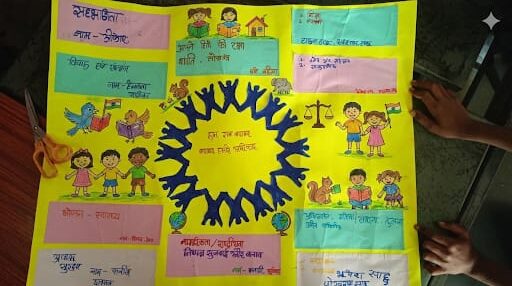
In the traditional architecture of an Indian classroom, power is strictly vertical. The teacher stands at the front, elevated on a podium, representing the unquestionable source of knowledge. The students sit in rows, looking at the back of each other’s heads, representing passive receptacles waiting to be filled. This physical layout is not accidental; it is a design meant to enforce compliance, silence, and hierarchy. It mirrors a society where authority is never questioned and wisdom flows only from the top down.
However, the image captured in the corridors of Includia Trust—titled “Peer Learning as Resistance”—tells a radically different story. It presents a scene that disrupts this centuries-old narrative. Here, the rows are broken. The podium is abandoned. Children from diverse backgrounds—spanning different castes, economic classes, and linguistic abilities—are clustered together, locked in deep negotiation and collaboration. The teacher is not the “sage on the stage” but a “guide on the side,” or perhaps, nowhere to be seen in the immediate frame at all.
This shift from a Vertical Hierarchy to a Horizontal Network is not merely a pedagogical preference; it is an act of resistance.
Why “Resistance”? In a social context deeply fractured by stratification, where adults rarely cross the invisible lines of community and status, a classroom where children rely on each other is a revolutionary space. When a first-generation learner explains a concept to a more privileged peer, or vice versa, the rigid structures of social superiority and inferiority begin to dissolve. The “Knowledge Authority” is no longer the property of the adult or the elite; it becomes a shared resource, generated collectively by the group.
At Includia Trust, we view Peer Learning not just as a method to improve test scores, but as a tool for democratic socialization. In the “Banking Model” of education (as critiqued by Paulo Freire), the student is an empty vault. In our model, the student is a co-creator. By turning to their neighbor for answers instead of the teacher, the child exercises Agency. They learn that solutions do not always come from above; often, they exist within the collective intelligence of the community.
This image captures the dismantling of the “Guru Syndrome”—the idea that one person holds all the answers. It validates the lived experience and cognitive potential of every child in that circle. It suggests that in a resource-poor environment, the greatest resource available is not the infrastructure, but the interdependence of the learners.
This article will explore the mechanics of this “Peer Learning as Resistance.” The revolution, as this image suggests, does not start with a speech; it starts with a circle.
1. The Sociology of the Circle
To understand the revolutionary potential of the image above, we must first understand the sociology of the straight line. The row-and-column seating arrangement is not neutral architecture; it is a manifestation of the industrial factory model and, in the Indian context, the caste-feudal hierarchy. In a row, you look forward to the authority figure. You turn your back on your peer. It is a structure designed for Isolation and Obedience.
The circle destroys this geometry. In a circle, there is no “front” or “back.” There is no place for the teacher to hide behind a podium. Everyone is equally visible. Everyone is equally vulnerable.
When Includia Trust implements this model in government schools, we observe a distinct sociological phenomenon: The Dissolution of Stratification. In a typical village, social life is strictly segregated by caste. A child from a dominant caste rarely interacts meaningfully with a Dalit child. However, the peer learning circle forces a Functional Interdependence.
If the task is to build a geometric model, and the Dalit child holds the glue while the Brahmin child holds the paper, the caste hierarchy is momentarily suspended by the necessity of the task. They are no longer “Upper” and “Lower”; they are “Holder” and “Gluer.” This is what Allport called the Contact Hypothesis—prejudice is reduced not by preaching, but by working together toward a common goal.
2. Cognitive Interdependence: The “ZPD” Network
Lev Vygotsky, the Soviet psychologist, introduced the concept of the Zone of Proximal Development (ZPD)—the gap between what a learner can do alone and what they can do with help. Traditionally, the “help” was assumed to be the adult teacher.
Includia’s model posits that the Peer is the Bridge.
THE TOWER MODEL
Teacher holds all knowledge.
Knowledge flows down.
Bottleneck: 1 Teacher, 60 Kids.
THE NETWORK MODEL
Knowledge is distributed.
Knowledge flows sideways.
Scale: 60 Teachers (The Students).
Why is a peer often a better teacher than an adult? Because of Cognitive Proximity. The teacher, an expert, often suffers from the “Curse of Knowledge”—they have forgotten what it feels like to not understand the concept. A peer who just learned the concept yesterday remembers the struggle. They remember the exact stumbling block. Their explanation is not “dumbed down”; it is “tuned in.”
Furthermore, the act of teaching is the highest form of learning. When a student explains a concept to their circle, they are engaging in Retrieval Practice and Elaboration. The circle turns every student into a teacher, effectively multiplying the teaching resources in the room by the number of students present.
3. Linguistic Resistance: Breaking the English Hegemony
In many Indian classrooms, English is not just a language; it is a gatekeeper. It silences those who think in dialects. The teacher teaches in formal textbook English (or Shuddh Hindi), and the first-generation learner, who speaks a local dialect (like Bhojpuri or Magahi), shuts down.
Peer learning groups act as a Linguistic Prism.
⬇
PROCESS: Peer Translation
⬇
OUTPUT: “Apni Bhasha (My Language)”
In the safety of the peer circle, the “official” language is stripped of its power. Students translate the high-concept academic terms into their local idiom. They use analogies from their own lives (farming, local festivals) that a textbook author in Delhi would never dream of.
This is an act of resistance against linguistic imperialism. It validates the student’s mother tongue as a vehicle for complex thought. When a child realizes they can discuss Photosynthesis in their local dialect, the concept ceases to be “foreign” and becomes “theirs.”
4. The Democracy of Error
In a teacher-centric classroom, a mistake is a public shaming event. The red pen is a weapon. Consequently, students stop taking risks. They stop raising their hands unless they are 100% sure. This creates a culture of Intellectual Cowardice.
In the peer circle shown in the image, the stakes are lowered. Making a mistake in front of 4 friends is infinitely less terrifying than making a mistake in front of 60 people and an authority figure. The peer group creates a Psychological Safety Net.
When a peer corrects you, it is usually a negotiation, not a judgment. “No, I think it works like this…” is different from “Sit down, you are wrong.” This allows for Iterative Learning—the freedom to draft, fail, redraft, and succeed without the fear of the permanent record.
5. The Gendered Silence
Finally, we must address the gender dynamics of the classroom. In mixed-gender classrooms in rural India, girls are conditioned to be invisible. They are trained to yield space, voice, and opinion to boys. In a plenary session (whole class), girls rarely speak.
The small peer group disrupts this silence. Includia Trust deliberately engineers groups to ensure gender parity or creates safe micro-climates. In a circle of five, it is difficult to hide. The structure demands participation. We have observed that girls who are mute in the main class become vocal leaders in the peer circle.
This is where the political nature of the model becomes most visible. By practicing voice, negotiation, and leadership in the micro-democracy of the circle, these girls are rehearsing for their role in the macro-democracy of the nation.
Conclusion: The Circle Unbroken
The image of students huddled together at Includia Trust is not just a heartwarming photo of group work. It is a blueprint for a different kind of society. It is a rejection of the idea that wisdom is scarce and must be hoarded by the few. It is an affirmation that wisdom is abundant and grows when shared.
By dismantling the teacher-centric hierarchy, we are not disrespecting the teacher. We are liberating them. We are freeing them from the impossible burden of being the sole source of truth. We are returning the ownership of learning to where it belongs: the learner.