
The Commodification of Curiosity: A Structural Critique of India’s Educational Market
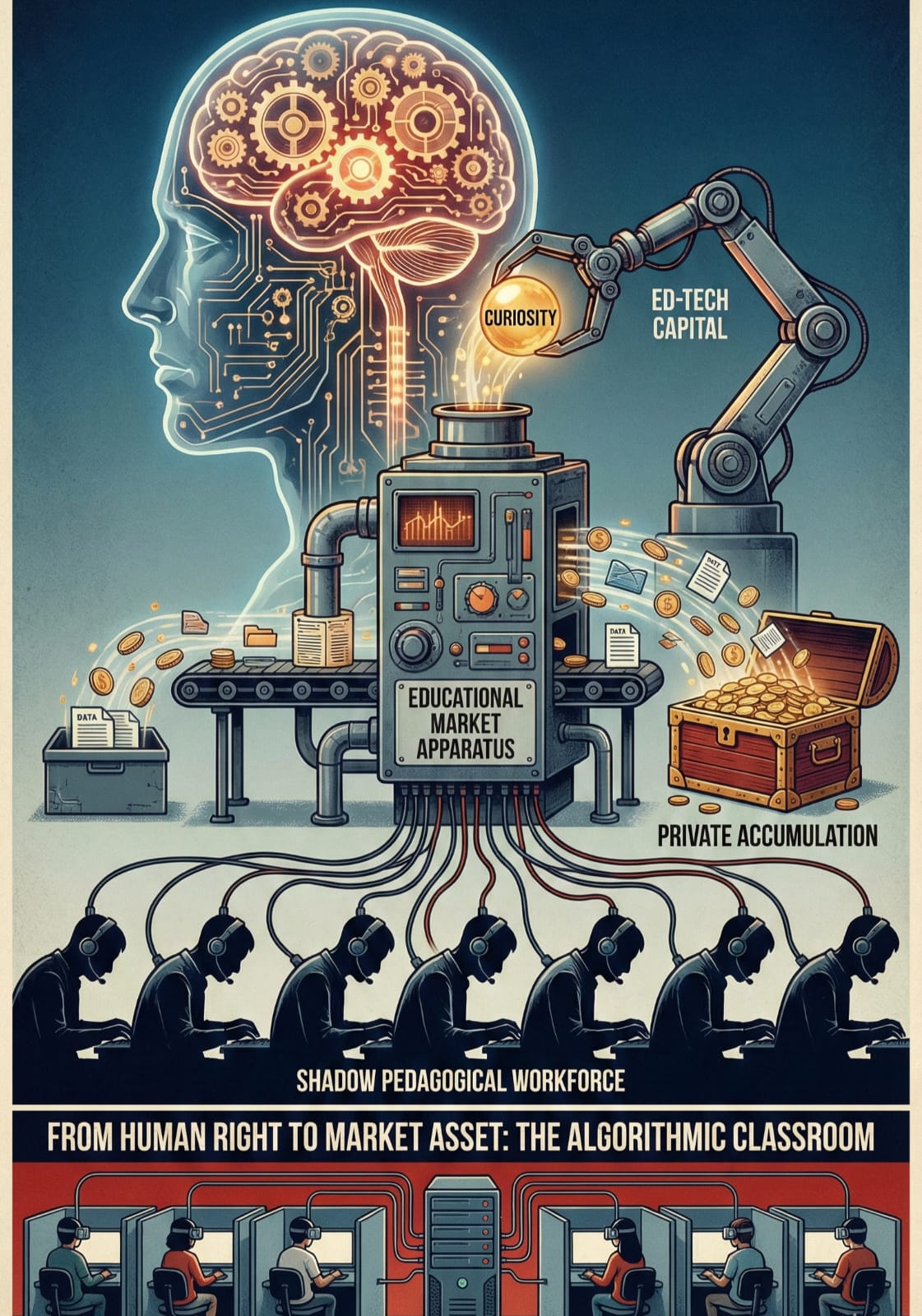
OBJECTIVE: To deploy a critical Marxist and socio-pedagogical lens to interrogate how contemporary educational capitalism in India converts innate human curiosity into a commodified asset, producing a systemic dependence on precarious pedagogical labor and algorithmically governed learners in order to sustain exponential ed-tech accumulation.
1. Defining the “Deficit Learner” as a Market Construct
In classical political economy, capital accumulation depends almost exclusively upon the extraction of surplus value from physical, industrial labor. However, in the contemporary knowledge economy, this logic has undergone a profound qualitative transformation: the primary site of extraction has shifted away from manual labor and deeply into the cognitive, affective, and aspirational domains of the human mind. Education is no longer merely a foundational social institution designed for collective betterment; it has been aggressively reorganized as a market apparatus. Within this apparatus, the fundamental, biological drive of curiosity itself is reconstituted as raw capital waiting to be mined.
The learner, therefore, is no longer perceived as a developing human subject dynamically embedded within a rich socio-cultural context. Instead, the learner is systematically framed through what can be termed a “deficit paradigm.” They are portrayed as an individual perpetually lacking, perpetually incomplete, and therefore perpetually in need of market consumption. This deficit is not a natural state of being; it is a condition that is systematically and intentionally produced by the institutions meant to serve them.
Rigid standardized testing regimes, relentless skill-based certification markets, and toxic employability discourses continuously redefine the parameters of what counts as “adequate knowledge.” By moving the goalposts of success, these systems ensure that the learner remains structurally insufficient. This manufactured insufficiency is the engine that fuels endless demand for paid educational interventions—coaching platforms, test-prep industries, and subscription-based online learning modules. Thus, the system does not respond to a genuine educational need; it actively creates the void it then sells the solution to fill.
Beyond Reductionism: The Suppression of Holistic Learning
When the profound process of education is reorganized strictly around market logic, it necessarily abandons its grounding in comprehensive Bio-Psycho-Social development and human rights frameworks. The deeply relational act of learning is brutally reduced to measurable outputs, and complex human cognition is flattened into easily digestible performance metrics.
| Cognitive Domain | The Commodified Market Reality (Data Extraction & Compliance) | The Emancipatory Pedagogical Ideal (Autonomy & Human Rights) |
|---|---|---|
| 1. CreatingHOTS (Suppressed) | Systematically Eliminated. Genuine creation is unscalable, algorithmically un-gradable, and unprofitable. The market views original thought as a disruption to standardized platform metrics. | Plurality & Radical Imagination. Learners and educators collaboratively construct new paradigms, socio-cultural futures, and equitable knowledge structures independent of corporate platforms. |
| 2. EvaluatingHOTS (Suppressed) | Compliance Over Critique. Students are discouraged from questioning the validity, bias, or power structures behind the curriculum. Ed-tech platforms dictate absolute algorithmic truths. | Critical Pedagogy. The capacity to deeply critique and dismantle existing ideological frameworks. Fostering a classroom environment driven by contextual dialogue, not top-down dictates. |
| 3. AnalyzingHOTS (Suppressed) | Fragmented Atomization. Complex systemic connections are broken down into isolated, micro-learning “modules.” Analysis takes time, which slows down the speed of consumption required by the platform. | Socio-Cultural Synthesis. Learners draw deep, meaningful connections between theoretical concepts and their localized, lived realities to understand structural inequalities. |
| 4. ApplyingLOTS (Exploited) | Algorithmic Conditioning. Training the “deficit learner” to apply rigid formulas to standardized testing scenarios. Applying knowledge strictly for short-term employability in the gig economy. | Community Praxis. Applying acquired knowledge and critical inquiry to solve real-world community issues, bridging the gap between the classroom and society. |
| 5. UnderstandingLOTS (Exploited) | The Illusion of Learning. Reduced to correctly selecting multiple-choice answers. “Understanding” is measured purely by digital engagement metrics (time-on-screen) rather than authentic comprehension. | Collective Meaning-Making. Deep comprehension achieved through relational, bio-psycho-social engagement between peers and mentors in a shared pedagogical space. |
| 6. RememberingLOTS (Exploited) | Speed & Accuracy. The primary site of extraction. Rote memorization is highly valued because it allows for immediate, automated assessment and the continuous generation of profitable user data. | Contextual Foundations. Retaining historical and cultural knowledge not as isolated facts for a test, but as the necessary foundation for deep, emancipatory critical thought. |
This commodification carries a direct, devastating epistemic consequence: the deliberate erosion of Higher Order Thinking Skills (HOTS)—the very capacities of critical thinking, creativity, and complex problem-solving that are central to advanced academic work and societal progress. Instead of nurturing genuine, open-ended inquiry, the marketized educational system aggressively privileges specific, measurable traits that align with algorithmic assessment:
- Speed over depth: Rewarding the rapid recall of facts rather than the slow, deliberate synthesis of complex ideas.
- Accuracy over understanding: Prioritizing the correct selection from a multiple-choice list over the ability to explain the fundamental “why” behind the answer.
- Compliance over critique: Training students to accept the parameters of the test rather than questioning the validity or bias of the curriculum itself.
The end result of this process is not outright ignorance, but rather controlled cognition—a populace trained to perform but structurally discouraged from challenging the status quo.
The Shadow Pedagogical Workforce
Running precisely parallel to the transformation of the learner is the emergence of a new, highly exploited class configuration within the educational sector—a Shadow Workforce of Pedagogy. This workforce comprises:
- Gig-based online tutors operating without benefits or job security.
- Underpaid para-teachers holding up crumbling public infrastructures.
- Contractual academic content creators ghostwriting curricula for platform monopolies.
- Data-generating students whose every click trains the proprietary algorithms.
These actors are structurally indispensable to the operation of the modern educational market, yet they are institutionally invisible. Just as early industrial capitalism absolutely required a reserve army of factory labor to maintain profitability, contemporary educational capitalism requires a massive reserve army of precarious pedagogical workers and endless data-producing learners. Their invisibility is deeply ideological; acknowledging their true centrality to the educational process would immediately expose the exploitative, extractive foundations upon which the entire ed-tech empire rests.
2. The Ed-Tech Industrial Complex as a System of Accumulation
To fully grasp the magnitude of this phenomenon, education must be analyzed not as a neutral, benevolent public service, but as an industrial complex primarily driven by international capital flows, aggressive venture funding, and the relentless pursuit of platform monopolies. The traditional classroom has been superseded by a networked ecosystem of extraction.
Educational capitalism intentionally produces what may be called a Relative Cognitive Surplus Population—a massive, unstable demographic consisting of overqualified but structurally underemployed educators, alongside hyper-anxious, endlessly consuming learners. This surplus is not an administrative oversight or a failure of state planning; it is a vital functional requirement for the market to thrive.
Education requires a standardized, predictable consumer.
Market logic applied to knowledge production and distribution.
Cognitive standardization aligned with scalable profit models.
Epistemic erosion, pedagogical de-skilling, and systemic precarity.
This system of accumulation expands and contracts violently in rhythm with broader capital investment cycles. During lucrative funding booms, ed-tech platforms rapidly absorb tens of thousands of educators and learners to artificially inflate user metrics. During inevitable market downturns or structural corrections, they are rapidly, ruthlessly expelled—revealing their ultimate disposability. Education, under this regime, becomes completely financially volatile and socially unstable.
A. The Three Battalions of Educational Labor
B. The Function of Precarity: Discipline Through Replaceability
We must understand that the persistence of this extreme precarity across the educational sector is not accidental; it is a highly tuned, disciplinary mechanism. The continued existence of a massive reserve pool of desperate educators ensures permanent wage suppression, absolute compliance with top-down standardized curricula, and the total elimination of pedagogical autonomy. This deliberately engineered environment creates what must be conceptualized as a profound Pedagogical Autonomy Crisis.
Impact of Replaceability on Learning
When well-meaning educators attempt to deviate from the platform’s script—perhaps by introducing critical pedagogy, integrating socio-emotional learning, or prioritizing highly localized, contextual knowledge—they instantly become economically vulnerable. Replaceability becomes the core mechanism of institutional control. Consequently, the intentional degradation of the teacher’s status directly and unavoidably leads to the deep impoverishment of the learner’s cognitive and emotional experience.
C. Digital Isolation and the Algorithmic Classroom
The rapid digital turn in modern education has not merely introduced neutral new tools into the classroom—it has fundamentally, and violently, restructured the entire social architecture of learning itself. In the algorithmic regime, learning is actively engineered to be individualized but utterly isolated; hyper-flexible but intellectually fragmented; highly accessible but completely decontextualized. The physical classroom, which historically served as a vital collective pedagogical space for democratic negotiation, has been entirely replaced by a sterile, algorithmic interface.
This structural reorientation inevitably produces a severe condition of social atomization. Learners are systematically disconnected from the grounding forces of community, stripped of the opportunity for genuine interpersonal dialogue, and denied the essential human experience of collective meaning-making. At the exact same time, their behavioral and cognitive data is continuously harvested, ruthlessly monetized, and fed back into the proprietary system solely to optimize future engagement—not to foster true understanding. We must be unequivocally clear: this is not education; it is pure, unadulterated cognitive extraction.
The “Say’s Law” of Pedagogy:
Manufacturing the Boxed Learner
1. The Market Rationality#EconomicDeterminism
Consider an entrepreneur who establishes a manufacturing or tech enterprise based purely on classical economic logic—such as Say’s Law (“Supply creates its own demand”). Driven strictly by profit motives, the company identifies a societal gap and begins producing goods. As the enterprise scales, it encounters a structural deficit in highly specialized labor (e.g., Data Scientists, algorithm engineers).
2. Institutional Subordination#InstitutionalIsomorphism
To fill this labor deficit, the manufacturer approaches an Educational Institution. The corporate demand is explicit: “We need a specific type of worker with these exact technical specifications.” Rather than acting as a guardian of holistic human development, the institution operates as a Subordinate Supplier. It immediately retrofits its higher-education syllabus to incorporate these exact requirements, prioritizing corporate utility over academic inquiry.
3. The Commodification of Desire#PedagogicalAlienation
This creates a fatal pedagogical illusion. The curriculum shift is justified by claiming it meets “student demand.” But we must ask: Did the children inherently desire to study these specific, isolated technical modules? No. Market forces manufactured the demand. The student is systematically stripped of their individual, organic approach to learning and is forcibly molded to fit into a pre-calculated structural box.
THE CRITICAL INTERROGATION
From the moment a child is born, they possess an unbounded, individual approach to understanding the world. Yet, the overarching social and economic structure immediately begins the violent work of fitting that child into a box. Why? Because the system requires standardized parts. The suppression of the learner’s individuality is not an accident; it is a mechanism designed explicitly for the personal benefit, profit, and extraction of the capitalist structure.
The Child (Innate State)
- Boundless, non-linear potential.
- Driven by intrinsic curiosity.
- Individualized cognitive approach.
- Seeks holistic social meaning.
The Box (Imposed State)
- Standardized, linear metric.
- Driven by extrinsic employability.
- Uniform institutional curriculum.
- Serves external corporate benefit.
FINAL CRITICAL INSIGHT
The commodification of education represents a profound ideological shift—from learning recognized as an inalienable, collective human right to learning downgraded as a private market transaction. Within this extractive system, curiosity is systematically mined, teachers are relentlessly deskilled, learners are forcibly standardized, and structural inequality is perfectly reproduced across generations. The most marginalized educators and students are not the failures of this system—they are the very structural foundation upon which this entire market operates.
Education cannot be reduced to content, metrics, or markets. It is fundamentally bio-psycho-social, deeply rooted in human relationships, cultural contexts, and critical dialogue. To transform education, incremental reform is entirely insufficient. What is required is a radical paradigm shift:
- ➔ From commodification to emancipation.
- ➔ From standardization to plurality.
- ➔ From profit to justice.
Until then, the system will continue to quietly convert curiosity into capital—and have the audacity to call it progress.