
Financial Literacy or Survival Arithmetic? The Burden of Cost-of-Living on Rural Households
OBJECTIVE: To critically examine if standard “budgeting” advice is applicable to families living in a state of permanent economic precarity. We argue that for the poor, math is not about saving; it is about stretching.
Imagine walking into a room where you are expected to spend six hours a day. The walls are bare, save for peeling paint and a faded calendar from three years ago. There is nothing to read, nothing to spark curiosity, nothing that reflects who you are. This is the reality for millions of children in rural government schools across India.
As an educator working with Includia Trust in tribal belts, I have seen how this sensory deprivation acts as a silent signal to marginalized children. It tells them: “This space is not for you. Your curiosity is not welcome here.”
A Print-Rich Environment is not about decoration. It is about justice. It is about surrounding a child with language until the fear of the written word vanishes.
Walk into a government primary school in a remote village in Jharkhand, Odisha, or rural Maharashtra. Close your eyes for a moment. What do you smell? Dust. Old lime plaster. Dampness. Now open your eyes.
What do you see?
In 80% of cases, you will see The Void. Four walls, painted a clinical, institutional whitewash (often peeling), a chalkboard that has turned grey with age, and perhaps a calendar from a local bank hanging crookedly near the door.
We treat these walls as mere structural necessities—barriers to hold the roof up and keep the rain out. But in the sociology of education, this empty space is not neutral. It is active aggression against the child’s curiosity.
When a child from a marginalized community—who perhaps lives in a mud home rich with texture, nature, and oral storytelling—enters this sterile concrete box, the environment silently screams a devastating message: “Leave your world outside. In here, only the textbook matters. In here, your imagination has no home.”
This article is a manifesto for the Print-Rich Environment. Not as “decoration,” but as a radical pedagogical necessity. We must turn the walls into The Third Teacher.
I. The Sociology of the “Third Teacher”
De-coding the Term
The concept originates from the Reggio Emilia approach (Loris Malaguzzi), which posits three teachers for every child:
- 1. The Adult: The trained educator.
- 2. The Peers: Other children who co-construct knowledge.
- 3. The Environment: The physical space.
In the context of the Elite (Urban Private Schools), the “Third Teacher” is lavish—AC rooms, iPads, colorful modular furniture. But for the Rural Poor, the Third Teacher is often “absent” or “hostile.”
For a first-generation learner, the classroom is the only place they encounter formal literacy. Their parents may not read; there are no bookshelves at home. Therefore, if the classroom walls are silent, the child’s opportunity for incidental learning (learning by simply looking around) drops to zero.
We are fighting against Symbolic Violence. When a tribal child sees a wall painted with “A for Apple” (a fruit they may rarely eat) instead of “A for Aam” (Mango) or “M for Mahua” (a local flower), the wall is telling them that their reality is invalid.
Let’s play a game to understand the cognitive load of a rural child. Imagine you have been teleported to a classroom in a country where you do not speak the language (let’s say, rural Japan).
Scenario A: The Empty Room
The walls are white. The teacher speaks only Japanese. You sit on the floor. There are no pictures.
Scenario B: The Print-Rich Room
The walls have pictures of a ‘Cup’ labeled in Japanese. There is a drawing of a ‘Sun’. Your own name is written on the door.
The Insight: In Scenario B, the walls “scaffold” your learning. Even if you don’t understand the teacher, you can learn from the wall. This is what our rural children are missing.
II. The Politics of Space: Who Owns the Wall?
In the current bureaucratic setup of the Indian education system, school maintenance is often a matter of “Tenders” and “Contracts.” The Block Education Officer releases funds for whitewashing. A contractor comes, sprays cheap lime, and leaves.
Sometimes, under the guise of “BALA” (Building As Learning Aid), artists are hired. But what do they paint?
- The Disconnect: They paint Mickey Mouse. They paint fair-skinned children in ties and blazers. They paint scenes of urban traffic lights in villages that have no paved roads.
- The Includia Approach: We argue that the walls must reflect the local ecology.
If the school is in a Santhal village, the walls should feature Sohrai art. The alphabet chart should use local references (e.g., ‘T’ for Tir/Arrow, not just ‘T’ for ‘Tiger’). When a child sees their culture elevated to the status of “educational material,” their self-esteem creates a fertile ground for learning.
III. Anatomy of a “Speaking” Wall
So, what does a functional, high-impact Print-Rich classroom look like? It is not just about hanging expensive flex banners. In fact, plastic banners are the enemy of organic learning. A speaking wall is dynamic, changing, and interactive.
1. The Word Wall
A designated space where new vocabulary is added weekly. Not printed, but hand-written on card paper.
Example: During monsoon, words like “Mud,” “Rain,” “Frog,” and “Thunder” are pinned up.
2. Student Ownership Zone
Crucial Rule: 50% of the wall space must be reserved for student work.
Even the scribble of a 4-year-old deserves a frame. This validates their output as “worthy.”
3. The Interactive Labels
Everything is labeled. The door says “Door/Darwaza.” The fan says “Fan/Pankha.”
The physical world becomes a dictionary. The child learns that objects have names that can be written.
IV. The Economic Argument (Low Cost, High Yield)
Neoliberal critics often argue that infrastructure upgrades are “too expensive.” This is a lie. A Print-Rich environment is one of the most cost-effective educational interventions possible.
It does not require iPads. It requires:
- Old Newspapers (for collage).
- Jute strings (to hang artwork).
- Cardboard waste (to make flashcards).
- Teacher Agency (the freedom to stick things on the wall without fear of “spoiling the paint”).
The Verdict
A sterile classroom is a leaky bucket. You can pour the best curriculum in, but if the environment does not hold the child’s attention or validate their identity, the learning leaks out.
The walls must speak because often, our children are too scared to. When the walls speak their language, the children eventually find the courage to join the conversation.
The Reading Corner:
A Nook of Dreams
In the sociology of Indian education, we face a peculiar paradox: The Museum of Books.
If you visit a standard government school, the Headmaster will proudly show you a steel almirah (cupboard). It is locked. Inside, stacked with military precision, are library books. They are dust-free, spine-intact, and utterly pristine.
To the bureaucrat, this is a success—the assets are “safe.”
To the educator, this is a crime scene.
These books are imprisoned. They are withheld from the children—often Dalit or Adivasi—under the unspoken prejudice that their “dirty hands” will spoil the “government property.” This is not just resource management; it is Casteist purity politics applied to knowledge. The book is treated as a sacred idol (Saraswati) to be worshipped from afar, not a tool to be used.
The Bureaucratic Trap
Teachers are often held financially liable if a book is lost or torn. This fear creates a perverse incentive:
“If I give the book to the child, it might break. If I lock it, I am safe.”
We must dismantle this logic. A torn book is a sign of a read book. A pristine book is a wasted opportunity.
From “Library” to “Reading Nook”
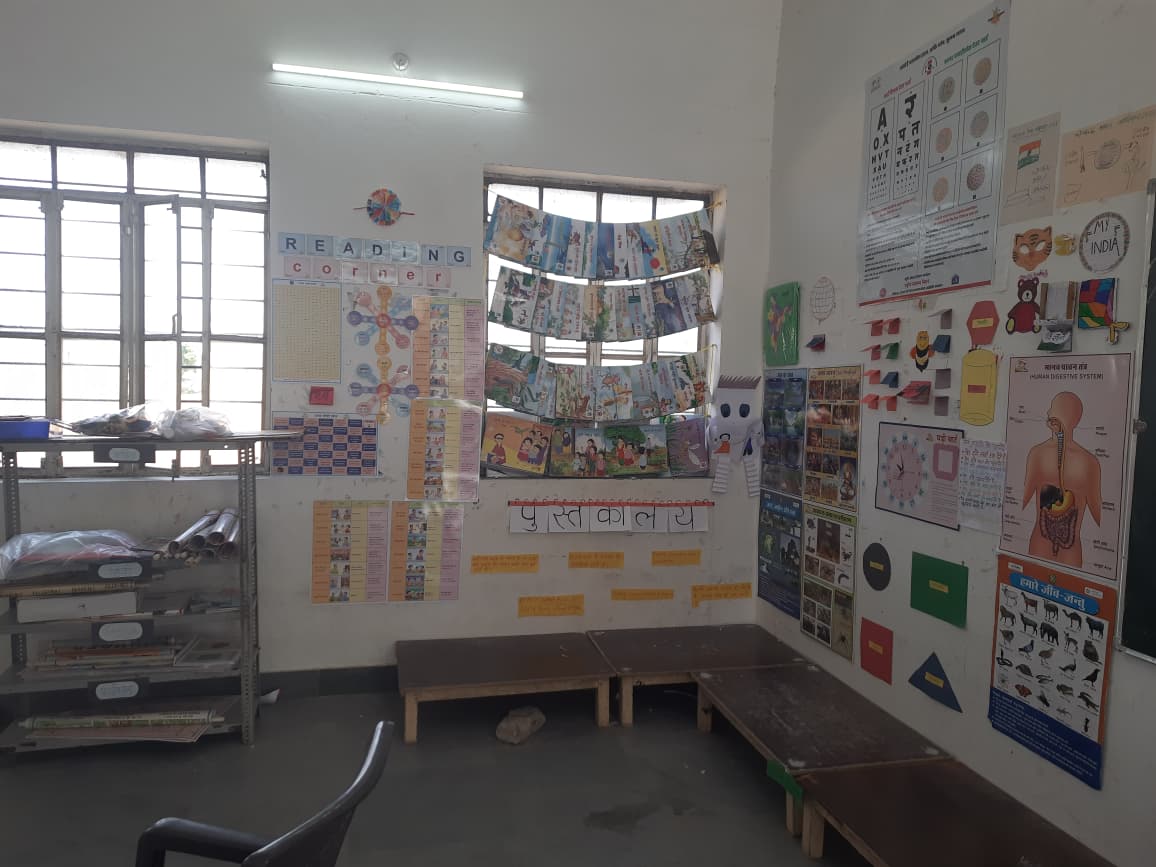
We do not use the word “Library” in our primary school interventions. The word “Library” invokes silence, strictness, and high shelves. We use the term Reading Corner (or Padhne Ka Kona).
This shift is spatial and psychological. A “Nook” implies safety. It implies that you can curl up. It implies that the body—and not just the brain—is involved in reading. For a child from a chaotic or resource-poor home, this corner becomes a sanctuary of imagination.
1. The Surface
NO DESKS. We use a Dari (rug) or straw mats. Reading is intimate. Children should be able to lie down on their stomachs or sit cross-legged. This breaks the hierarchy of the teacher-student dynamic.
2. The Display
COVERS OUT, NOT SPINES OUT. A child who cannot read yet chooses a book by its picture. Traditional libraries stack books spine-out to save space. We must display covers to seduce the reader.
3. The Height
EYE LEVEL. If a child has to ask a teacher to reach a book, the barrier is too high. The books must be within the grasp of a 6-year-old.
4. The Content
MIRRORS & WINDOWS.
Mirrors: Stories about their own village/lives.
Windows: Stories about the wider world.
The Psychology of Access: A Simulation
Imagine you are 7 years old. You see a colorful book about a tiger.
Choose the environment:
The Closed Cupboard
You ask the teacher for the book. She says, “Wash your hands first.” She watches you nervously as you turn the pages. You feel anxious. You return it quickly.
The Open Nook
The book is on a low string. You grab it. You sit on the mat. You look at the pictures. You laugh. You show your friend. No one is watching.
“When we trust a child with a book, we are telling them: ‘You are worthy of knowledge.’ The Reading Corner is not just about literacy; it is about dignity.”
In the Includia Trust model, a book that is torn from overuse is a badge of honor. A book that remains brand new after three years is a badge of shame. Let us unlock the cupboards. Let the pages get dirty. Let the dreams escape.
Low-Cost, High-Impact:
A Practical Guide
The greatest lie sold to the Indian education system is that “innovation requires budget.” This is a neoliberal trap designed to make schools dependent on external vendors, EdTech tablets, and corporate CSR funds.
At Includia Trust, we operate on the philosophy of Resourcefulness as Resistance.
If we wait for the government to send “Teaching Learning Materials” (TLM), a generation will pass. We must look at what is already abundant in the village: Trash, Nature, and the Children themselves.
RESOURCE AUDIT
Fig 1: The economics of a Print-Rich Classroom.
The Wall of Ideas
Here are the three pillars of low-cost intervention. We call this the “Scavenger Pedagogy.”
Tactical Breakdown
1. The Newspaper Strategy
In many rural homes, books are scarce, but old newspapers are often available (or can be bought by the kilo cheaply).
- Circle the Letter: Ask Class 1 students to circle every letter ‘M’ they find on a page. This builds visual discrimination.
- Image Stories: Cut out a photo (e.g., a cricket match or a politician waving). Ask the child to invent a story about what is happening.
2. Trash to Treasure
Packaging waste is vibrant, colorful, and durable.
- Biscuit Wrappers: Use them to teach colors and nutritional information.
- Cardboard Cartons: Flatten them to create “Word Walls.” Unlike paper, cardboard doesn’t tear easily and stands upright.
3. Nature as the Text
Why buy plastic counters for math when the playground is full of pebbles, seeds (tamarind seeds are excellent), and twigs?
The Activity: “Nature Alphabet.” Ask children to form letters using twigs and leaves on the floor. This adds a tactile (touch-based) dimension to literacy, which is crucial for motor skill development.
“We do not need smart classrooms. We need happy classrooms. And happiness does not cost lakhs of rupees. It costs attention, care, and a little bit of glue.”
Conclusion: From “Decor” to “Dignity”
We began this analysis by observing the “Dead Space” of rural classrooms—the silent, peeling walls that host millions of India’s most vulnerable children. We end by recognizing that this silence is not an accident of poverty; it is a structural failure of imagination.
When we advocate for Print-Rich Classrooms and Reading Corners, we are not asking for interior decoration. We are asking for a fundamental redistribution of Cultural Capital.
The Final Word
When we deny a rural child a stimulating environment, we are essentially saying that they deserve the bare minimum. At Includia Trust, we believe that beauty is a right, not a privilege.
Let us tear down the invisible barriers. Let us cover the cracks in the walls with stories, poems, and art. Let us turn every classroom into a celebration of the child’s potential.
— Pankaj Munda