
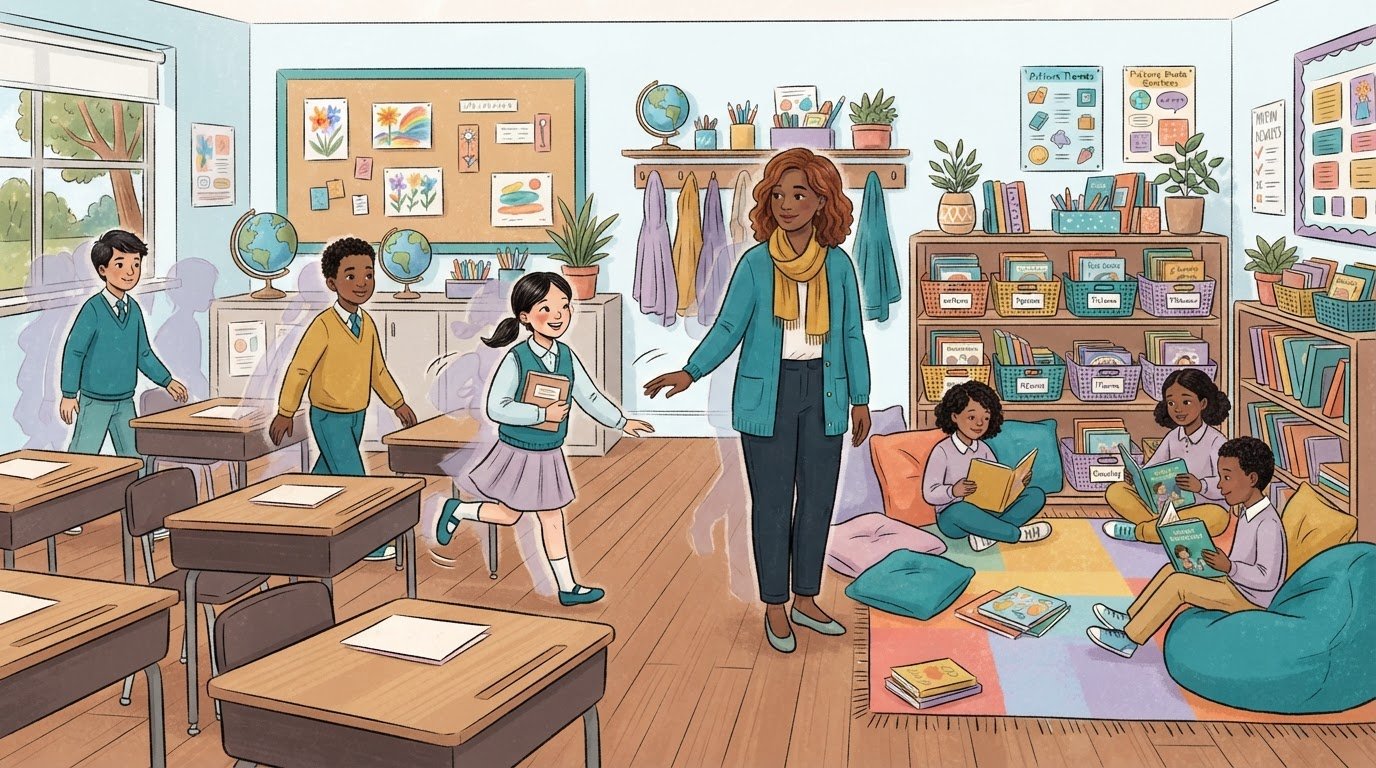
Lesson plans usually give attention to the opening, explanation, activity, and assessment. The transition between these parts may receive only a few words: “Now do the worksheet,” “Move into groups,” or “Take out your books.” Yet transitions are not empty space between learning activities. They are moments when learners must understand what is changing, gather materials, move, organise themselves, and begin again.
When these steps are unclear, the teacher may spend the next several minutes repeating directions or resolving avoidable confusion. The class can appear noisy or uncooperative, even though the problem is partly a routine that has not been made visible. A transition is a small piece of teaching that prepares the next piece.
Why transitions need a purpose
Every change of activity asks students to shift attention. A discussion becomes individual writing; a reading becomes a group task; materials move from the board to desks. Learners who need more time to process instructions, find equipment, move safely, or understand the new expectation can be left behind when directions are given only once and quickly.
Planning a transition is not about making every movement silent or mechanical. It is about making the next step predictable enough that students can use their energy for the learning itself. Predictability can reduce unnecessary uncertainty while still allowing a classroom to feel active and human.
Make the change visible
- Signal the change: use a consistent verbal cue, visual sign, or short countdown that is not dependent on shouting.
- Name the next action: “Close the book, keep your pencil, and turn to your partner” is more useful than “Get ready.”
- Show the materials: if the next task needs three items, display or list them.
- Give a first step: students should know what to do after they reach the new place.
- Build a realistic pause: some learners will need additional time. Avoid designing the transition around the fastest student.
1. Finish and put away the current material. 2. Start the next task with one clear action. Keep the directions short enough to remember and visible long enough to use.
Notice what the transition tells you
Observe where time is actually spent. Are students waiting for materials? Do they ask the same question repeatedly? Is the route across the room crowded? Do they know whether to work alone or with a partner? A transition problem may be a materials problem, a direction problem, a space problem, or a timing problem. The teacher does not need to interpret every difficulty as behaviour.
It is useful to rehearse a routine at the beginning of the year, after a break, or when the activity changes. Explain why the routine exists, practise it once, and then review what still feels confusing. Repetition is not wasted when it creates independence.
Reflection for teachers
- Which transition regularly takes longer than expected?
- What is the one instruction learners need to remember?
- Could materials be placed or distributed differently?
- What support would help the student who needs extra processing time?
We cannot control every interruption in a classroom. A missing book, a late arrival, or an unexpected question may change the plan. But the transitions we can prepare are worth preparing. A calm, clear change of activity protects time, reduces friction, and helps learners enter the next task with a sense of direction.