
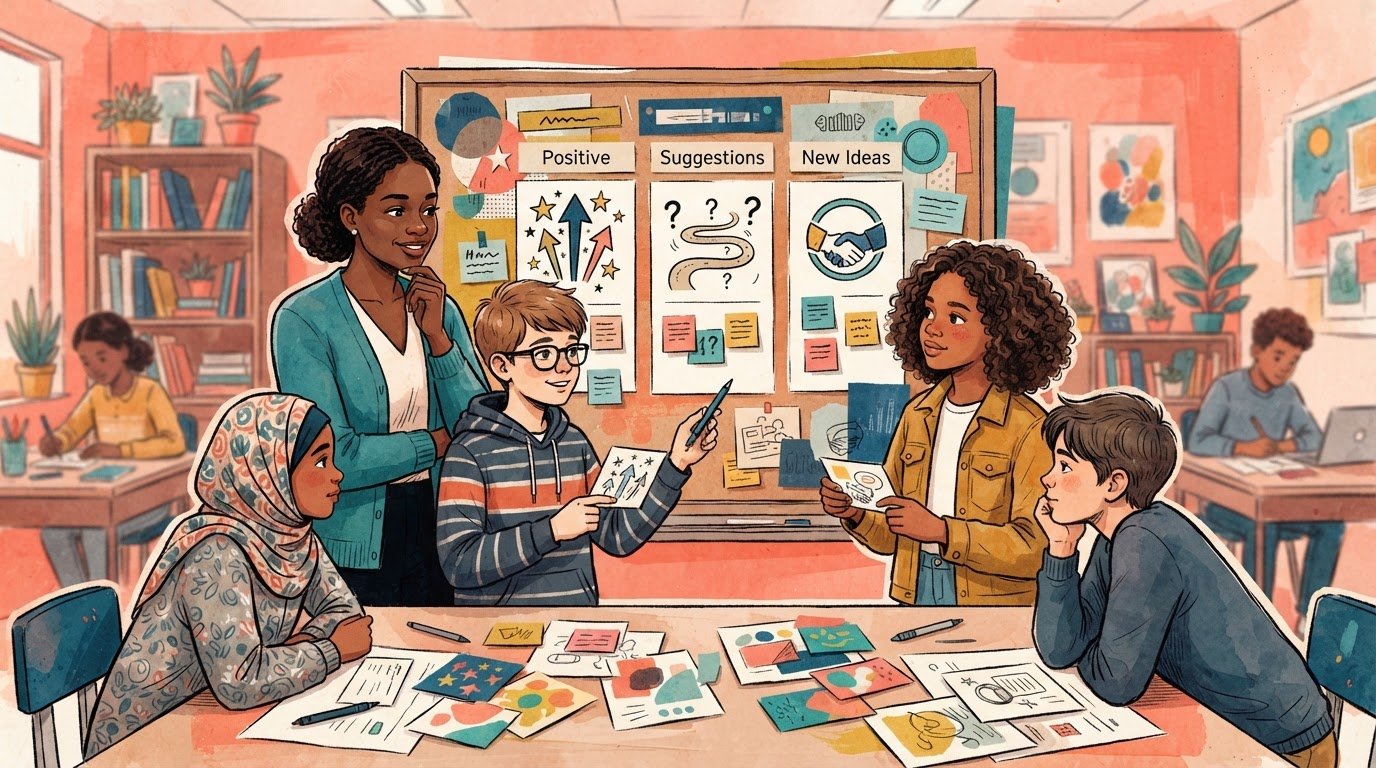
Schools and classrooms often create moments for student voice: a question at the end of a lesson, a suggestion box, a class discussion, or a short reflection form. These opportunities can be valuable. Yet there is a quieter part of student voice that deserves attention: what happens after students share something?
If learners are repeatedly asked what they think but never see a response, the invitation can gradually feel ceremonial. They may wonder whether feedback matters or whether adults have already made every decision. A classroom that listens should be able to explain how listening changes—or sometimes does not change—what happens next.
Close the loop without promising everything
Responding to feedback does not mean every request must be accepted. A student may ask to remove all written work, change a deadline, or choose an activity that is not possible within the lesson. Teachers and schools have responsibilities, constraints, and learning goals. The important thing is to avoid treating a request as if it disappears into an invisible box.
A follow-through can be simple. The teacher might say: “Several of you found the instructions confusing. I will show a short example tomorrow.” Or: “You asked for more time to discuss. We cannot extend every activity, but I can build in a two-minute partner check before the written response.” This makes the relationship between feedback and action clear. Even when a suggestion cannot be adopted, a reasoned response respects the learner.
A manageable feedback cycle
- Ask a specific question. Instead of “How was class?”, ask which step was clear, confusing, useful, or difficult to begin.
- Offer a safe way to respond. Learners may speak, write anonymously, use a quick scale, or share with a partner.
- Look for patterns, not one loud opinion. A single comment may be important, but the teacher can consider it alongside other evidence.
- Tell students what you noticed. Summarise the feedback without exposing a student.
- Make a small change or explain a limit. Identify what will be adjusted, tested, or kept and why.
Ask → Listen → Notice → Respond → Revisit. Student voice becomes more credible when learners can recognise the response, not only remember the question.
Feedback as a relationship
There is also a responsibility to avoid using feedback as a popularity vote. Classroom decisions should not be based only on what is easiest or most immediately enjoyable. Learners can be invited to explain their needs and reasons; teachers can then connect these reasons with the purpose of the lesson, safety, fairness, and available time. This is a chance to model thoughtful decision-making rather than simply saying yes or no.
Questions worth keeping
- What is one classroom routine students can meaningfully influence?
- How will they know their feedback was read?
- Can we share a change and its reason in the next lesson?
- What do we need to learn from a suggestion we cannot implement?
Student voice is not measured by the number of times we invite students to speak. It is measured, in part, by the quality of the response that follows. A visible follow-through tells learners that their thoughts are taken seriously and that participation involves both speaking and being accountable to one another.